Monday, December 20, 2021

The 1st Reverse Product Placement


The Pass the Heinz tag line was pitched by fictional ad man Don Draper on the TV show Mad Men.

It was rejected on the show ...

... but not in real life.


50 years after the Mad Men timeline, Heinz ran the campaign pitched by Draper.

The first ever "reverse product placement.”


The result?

Heinz’ most talked about and efficient ad campaign ever.


Heinz’s actual advertising firm David Miami co-credited the campaign to the nonexistent Sterling Cooper Draper Pryce (Draper’s agency). The stunt was scheduled to coincide with the tenth anniversary of the premiere of Mad Men.


Tuesday, December 14, 2021

Advice for Writers from Billy Joe

Billy Joe Shaver - Simplicity don't need to be greased.

“Simplicity don’t need to be greased.”


Those are the words of country outlaw singer/songwriter Billy Joe Shaver.

It’s how he responded when hearing his songs described as simple and compelling.


Simplicity don’t need to be greased.


Keep that quote in mind while working on your next assignment.


Shaver, the man who Willie Nelson believed "may be the best songwriter alive today," once offered some detail about his straightforward approach:

“I’d like to say as few words as I can and as plain as I can, uncomplicated as I can what I’m gonna say. And that way the dumb ones will get it, like me. And the smart ones will get it easy. So, I’ll keep it there. I know my limitations and I’m into simplicity.”


Monday, December 6, 2021

Critical Copywriter Questions

20 Questions for Copywriters

You've been recruited to write copy.

The first and most important question to answer is: Does this product or service really work and is there a demand for it from a definable target audience? 

Then there are some basic business questions you need answers to get the deal done and off to a good start:
  1. Is the person recruiting me the person who makes the hiring decision?

  2. Can they afford to pay me and are they willing to agree to my terms?

  3. Is the scope of the project clear to both you and them?

  4. Who has final sign off on the copy?

  5. Can they provide adequate information about their target audience?

  6. Can they substantiate their claims?

  7. Can they articulate what they specifically want/need to happen once their target audience reads the copy?
Once it looks like the relationship can be successful, you must extract information so you can get started on the copy:
  1. Who -- exactly and in detail -- is the target audience? 

  2. What problem does the product/service solve for the target audience?

  3. How is that problem painful to the target audience?

  4. What does having the problem solved look like to the target audience?

  5. What is currently stopping the target audience from solving the problem?

  6. What proof is available to demonstrate the product/service solves that problem?

  7. How is the product/service different from the competition?

  8. Why did current customers choose this product/service?

  9. What is the offer?

  10. How does the offer solve the problem for the target audience?

  11. What does the target audience's situation look like after activating the offer?

  12. How does the target audience activate the offer?

Sure there might be some more questions to ask to drill down for detail. 

Where necessary, drill down on details to make sure you have a full answer to each question.


Keep in mind, if you want to be successful: 
  • write for good products/services that are in demand

  • make sure the business relationship starts on solid footing

  • get the information you need to properly identify the target audience

  • understand why the target audience wants/needs the product service

  • have an attractive offer with clear direction on how to get that offer


Sunday, November 28, 2021

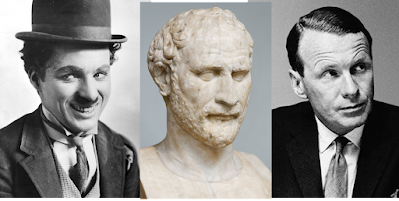
Charlie Chaplin, Demosthenes, & David Ogilvy

 I’m glad you appreciate my writing, but …

Charlie Chaplin, Demosthenes, David Ogilvy

In a discussion on classic film comedy, a critic said that when he watched Charlie Chaplin he thought to himself that he was watching a comic genius at work, but when he watched Laurel and Hardy, he laughed.

Which is reminiscent of a story from a few thousand years ago, that David Ogilvy referenced in a famous quote about advertising:

I do not regard advertising as entertainment or an art form,
but as a medium of information. When I write an advertisement,
I don't want you to tell me that you find it creative. I want you to
find it so interesting that you buy the product. When Aeschines spoke,
they said, "How well he speaks." But when Demosthenes spoke,
they said, "Let us march against Philip."

Don’t let your writing distract your audience. Keep them focused on the offer, why they want/need it, and how to access it.

Go for more Demosthenes and less Aeschines.


10 Items or Less

  "10 items or less" ... somewhere, a grammar lover is gripping the shopping cart extra hard. Technically, it should be "10...