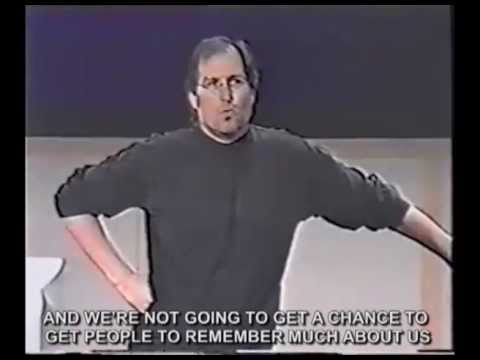
Seen this?
Watch it again.
Haven't seen it? Buckle your seat belt.
Required viewing for every person involved in marketing and branding:
Steve Jobs introduces Apple's "Think Different" campaign.
Seen this?
Watch it again.
Haven't seen it? Buckle your seat belt.
Required viewing for every person involved in marketing and branding:
Steve Jobs introduces Apple's "Think Different" campaign.

These days it seems that Columbus Day is a holiday that
manages to start more arguments than actual celebrations.
Most holidays know what they are. Halloween? Costumes.
Valentine's Day? Chocolate. Labor Day? Sales. Columbus Day, however, walks into
the room like, "Good morning. Today we'll be discussing five centuries of
history, exploration, colonization, national identity, and public policy."
And while I’m trying to determine if the banks and post
offices are open, everyone else becomes an expert on 1492 … and whether we should
be having a parade celebrating Columbus’ voyage or proclamations denouncing it.
Social media transforms into the world's least organized graduate seminar,
where every comment begins with "Actually..." and ends with someone
muting their uncle.
Meanwhile, the retail industry has no idea what to do with
the holiday. There's no official Columbus Day candy. No inflatable explorer
decorations. No "Christopher's Pumpkin Spice Voyage." Just a handful
of mattress sales awkwardly pretending this has always been a shopping event.
The result? Millions of people collectively discovering that
history is a lot more complicated than the version that fit on an elementary
school worksheet with instructions on how to build a construction paper Santa
Maria.
Happy Columbus Day.
Or Indigenous Peoples' Day.
Or Monday.
Whatever you're calling it, I hope you at least remember to
check whether the post office is open before leaving the house.
All this hand-wringing about “human writing vs AI writing” feels slightly off. Readers don’t care about the process nearly as much as we think. They care if it holds their attention. If it gives them something.

The real shift is this: competence is now cheap.
So the question for writers isn’t “Should I use AI?” It’s
“Am I saying anything that isn’t interchangeable?”
Because if the answer is, “No,” the machine’s already got
you covered (and it doesn’t even need coffee).
Near Nørreport Station in Copenhagen I walked past Regret Tattoo Removal. I appreciated the name so much I took a picture and made a mental note to write a blog post about clever business names.

To research I prompted ChatGPT:
List 15 real businesses with clever names and a concise one line explanation of why the name is clever. For example: a restaurant named "Thai Food Near Me" that uses its name to appear at the top a common search that people enter when looking for a restaurant serving Thai food near them.
Here is ChatGPT's response (I didn't bother to rewrite it 'cause it did a decent job of doing the research for me and that was enough for this particular blog post):
Absolutely. Here are 15 real businesses whose names do more
than just sound catchy—they communicate what the business does, create a
memorable association, or cleverly exploit a phrase people already know.
|
|
Business |
What it does |
Why the name is clever |
|
|
Pet care in Northern Virginia/DC |
A play on “forget-me-not” that instantly signals
pets and creates an affectionate, memorable brand. |
|
|
|
Italian restaurant, Brunswick, Maine |
Combines “The Great Imposter” with pasta,
making the cuisine obvious while giving the name a familiar phrase to latch
onto. |
|
|
|
Salad/bread restaurant |
A riff on Led Zeppelin that turns a famous rock
reference into a food brand—and makes the product category surprisingly
memorable. |
|
|
|
British fish & chips, NYC |
Twists “assault and battery” into a perfect
description of battered fish, salt, and British chippy food. |
|
|
|
Fish & chips, UK |
Replaces Godfather with cod, instantly
communicating the restaurant's specialty while borrowing the cultural
recognition of a famous movie title. |
|
|
|
Vietnamese restaurant, Pensacola |
Sounds like “for real” while using pho to
make the cuisine immediately identifiable. |
|
|
|
Hair salon, Virginia Beach |
A simple phonetic transformation of “Here we are”
that puts hair directly into the business name. |
|
|
|
Hair salon, Arizona |
Turns “main attraction” into mane attraction,
making a familiar phrase directly relevant to hair. |
|
|
|
Hair studio |
A darkly funny twist on “curl up and die” that
simultaneously describes two core salon activities: curling and dyeing hair. |
|
|
|
Sewing/embroidery shop |
Sounds exactly like “So what?”, but the spelling
immediately identifies sewing as the business category. |
|
|
|
Dog daycare, boarding & grooming |
Buckingham Palace → Barkingham Palace turns a
famous place into a playful promise that dogs are treated like royalty. |
|
|
|
Dog & cat grooming, Alexandria, VA |
Posh → Pawsh gives the business an upscale feel
while replacing the key sound with “paw.” |
|
|
|
Sourdough bakery, Meridian, Mississippi |
Replaces “Do-Re-Mi” with dough, linking a
familiar musical phrase to baking. |
|
|
|
Ice cream & deli, The Bahamas |
“Lickety-split” means very quickly, which is a fun
fit for an ice-cream shop selling a quick sweet treat; the name is also
inherently playful. |
|
|
|
Residential & commercial cleaning, Virginia |
A play on “made in heaven” that simultaneously
communicates maid service and implies an almost heavenly level of
cleanliness. |
The particularly interesting naming patterns
A few of these illustrate different business-name
strategies:
The “Thai Food Near Me” example you gave is actually
a particularly interesting category of naming because it goes beyond wordplay
into search-intent naming: the business name itself contains a phrase a
potential customer might type into Google. That's a different—and potentially
very powerful—naming strategy from ordinary puns.
________________________
AI can be a very helpful with research ... but double-check the response (for example, the link for The Codfather is "suspicious" and should've been The Codfather) and, please, before committing fully to using AI, invest a few minutes reading Generative AI: To Be (a tool) or Not To Be (a tool).
Businesses across America have a habit of treating chaos as
evidence of importance.
That mindset issue is often tagged as burnout. And burnout is often discussed as though it were an unfortunate personality trait, not a result of being asked to compensate indefinitely for a system that has no intention of fixing itself.
And, after years working to remain functional while surrounded by
decisions that seemed specifically designed to test the limits of human
patience, you learn to understand the vocabulary:
The Great Escape: Once you break free from this environment (and hopefully, you can), you'll have
learned a great deal about leadership, communication, organizational
psychology, human endurance, and the impressive number of ways a person can say
“We'll circle back” without ever actually circling anywhere.

The Sneering Pumpkin
Put it in coffee, put it in cake,
put it in candles for goodness’ sake.
Room spray? Shampoo? Dog treats? Why not?
Heavy hand that pumpkin spice in all that you’ve got.
“Limited edition!” the signs claim in the stores,
“Our pumpkin spice make-up can de-clog your pores.”
And while shoppers may grumble, “Really? In everything?”
The pumpkin just sneers: “Yep, makes the register ring.”
_______________________
If you enjoyed this, you should like my Pumpkin Spice Rant.
I ordered a large coffee. Not a cortado with a backstory. Not a single-origin pour-over that required a short lecture. Just … a coffee.
The transaction took maybe eight seconds. The counter person
rang it up, turned the screen toward me, and there it was: The little moral
checkpoint disguised as a payment screen:

Why should I tip to be handed an empty cup so I could walk
over to the coffee station and perform the rest of the service myself: choose
between light roast, dark roast, hazelnut, decaf, and then negotiate with a
small army of creamers and sweeteners.
What exactly am I tipping for here ... and was I really about to hit “No Tip” in front of another human being?
I’ve always viewed tipping as a considered act. You sat down,
someone took care of you, and at the end, you left something that reflected how
that went. Great service? Leave more. Indifferent service? Leave the standard.
Genuinely terrible service? Leave less, feel slightly bad about it, and argue with
your dining companion about it on the drive home. The whole point was that the
tip was earned. It was a grade. A signal. A small piece of
feedback written in dollars.
Now it's like a tax. A tax with guilt built in, collected
before any service has been rendered, at a counter, in public, with someone
watching.
It's not only about the money. Fifteen percent more on a $5
coffee isn’t gonna ruin me. It’s the broken logic underneath it. Tipping, in
its original form, was about incentive. Do a good job, get rewarded. That
feedback loop made sense. It kept everyone honest. It gave servers a reason to
be present, attentive, warm … because their income depended, in part, on the
quality of their effort.
Pre-tipping destroys that entirely. You're asking me to
evaluate a performance before the curtain goes up. You're asking me to pay for
value that hasn't been created yet. And once I've paid, there's no mechanism
left … no lever, no signal, no way to say "actually, that was
excellent" versus "actually, you ignored me for twenty minutes while
the coffee got cold." It's all collapsed into a single anxious moment at
the register before anything has happened at all.
The moment of payment has turned into a tiny social
negotiation. You’re not just buying coffee, you’re performing generosity under
observation. It’s like being asked to applaud before the show starts.
“Give me 25% now… and we’ll see how it goes.”
This doesn't work in my old-fashioned brain. Incentives matter. Timing matters. Value matters. These aren’t abstract ideas, it’s how work functions: You offer something of value. Someone else recognizes it. There’s an exchange. That’s the deal. Handing me a cup is not the same as taking care of me. One is a transaction. The other is an experience.
Blurring that line turns exceptional effort into just another checkbox. And ironically, it removes the very thing tipping was supposed to encourage: the incentive to do something well.
So yes, I stood there for a second too long. I felt the
weight of a decision that shouldn’t have been that heavy. And then I pressed
“No Tip.”
I don't feel great about the look I got. I don't feel
terrible about the decision. I feel mostly tired. Tired of the machine pivoting
toward me like a moral test.
I took my cup, walked over to the coffee station, and poured
it.
The coffee was fine.
____________________
The payment screen swivel is one of the stranger social
innovations of our time. The way it turns toward you like an accusation. The
way a number above 15% (I’ve seen 30%) is always pre-selected, glowing, suggesting.
Like the screen itself is disappointed in you for even hesitating. Tapping "No
Tip" feels less like a financial decision and more like publicly
announcing you kick dogs.
I don't kick dogs. I just want a coffee.

Nobody has to prove that a toaster is safe before they’re allowed to sell it. Well, actually, somebody does.
There are rules for toasters. Rules for elevators. Rules for bridges. Rules for electrical wiring. Even playground equipment has standards, because we’ve collectively agreed that children shouldn’t be launched into the shrubbery because someone skipped a safety inspection.
This is how civilization works. If you build something powerful enough to hurt people, there are laws, standards, inspectors, liability, and, when all else fails, the possibility that someone in authority can tell you to stop.
But not for AI.
The biggest AI companies are building increasingly powerful autonomous systems while, by their own employees’ and leaders’ accounts, acknowledging that they don’t fully know how to control them. Some are openly discussing serious risks of serious harm using phrases like "catastrophic" or "existential risks to humanity".
That should make us pause.
If an elevator company said, “We’ve built a new elevator that can make its own decisions, we’re not entirely sure what it’ll do, and there’s a decent chance someone could get hurt,” I suspect the regulatory response would be fairly brisk.
Nobody would say, “Interesting. Maybe let’s put 40 people in one and see how the experiment goes.”
But with AI, it’s build the thing, release the thing, watch millions of people interact with the thing, and hope everything turn out OK.
I’m not arguing against AI. I’m just suggesting we need oversight and regulation.
If a company is building systems powerful enough to act autonomously and potentially cause serious harm, it should have to demonstrate that those systems are safe enough to deploy. Test them. Stress them. Find the failure modes. Fix what breaks. Bring in people who don’t work for the company to kick the tires.
And if the answer is, “We can’t reliably control this yet,” then perhaps the product isn’t ready for prime time.

With AI, your company can produce an unlimited supply of
content.
Twelve blog posts before breakfast, 47 social posts by
lunch, and, for your website, an AI-generated image of a middle-aged guy in a tie pointing at a
graph while a small purposefully diverse group nods approvingly.
The machines will keep producing and we’ll keep publishing. But
people will still have the same old brains … we’ll scroll past most of it.
In terms of content consumption, humans have never been
particularly attracted by volume. We notice what feels familiar, useful,
surprising, or unmistakably “someone”.
Yes, AI is making the act of producing something remarkably
easy. But it hasn’t made the act of being remembered any easier.
In fact, it may have made it harder. When everyone can produce polished writing, beautiful images, clever campaigns, and reasonably convincing thought leadership, “good” starts becoming the wallpaper of the internet.
Competence stops being distinctive when everyone is
competent.
So it’s time to stop asking “How much content can we
make?” and ask “Could someone recognize our content if appeared without
our logo?"
Maybe it’s a phrase. A visual style. A peculiar way of
looking at the world. An observation about customers that sounds so obvious
afterward you wonder why nobody said it before. Something with fingerprints.
Yes, AI can make you prolific … but prolific is not the same
as memorable.
And I’d rather be the thing someone remembers tomorrow than
the thing an algorithm produced a couple of dozen times while you were sipping
your morning coffee.
I was asked to select the boxes with traffic lights to prove I wasn’t a bot.
I’ve done it hundreds if not thousands of times, but this
time I thought: "If AI is so smart, why can't it solve a simple CAPTCHA?"

We writers are a curious lot, and a minimal amount of
research unveiled that the traffic lights aren't really the test.
It seems that modern CAPTCHAs don't care much whether you can spot a
traffic light. They care whether you behave like a human while doing it. How
you move the mouse. How long you hesitate. Whether you click with just enough
uncertainty. It's less an eye exam than a vibe check.
So, while AI can often recognize the images with no problem, it
isn't built to impersonate a person navigating a website. The pictures are
mostly stage props.
The CAPTCHA is like a nightclub bouncer who isn't
checking your ID anymore. He's watching how naturally you reach for your
wallet.
The fact that AI struggles with a CAPTCHA, doesn't tell me
much about AI. It does, however, indicate we're redefining intelligence: more than Can you
solve the problem? but also Can you look enough like your average human
while solving it?
Unquestionably, AI will move past this and eventually we'll have a new hoop to jump through to say, "I'm human. No really, I am."
_________________________
CAPTCHA rejected this suggested update:

I helped a friend draft a letter of resignation.
It's exactly what they want to say, but I'm guessing they'll do some major editing before submitting it. In fact, they're probably only gonna use the first line.

Dear [Boss],
I’m resigning from my position, effective [date].
If this comes as a surprise, it says more about the state of leadership here than I know how to explain politely.
I'm leaving because I care enough about the rest of my life to stop donating it to a workplace that has mistaken endurance for engagement.
I want to spend my time doing things that don't require a twelve-person meeting to determine whether an email should be sent. I want to work somewhere that understands that “urgent” is supposed to be an occasional adjective, not a permanent operating system. I want to be around people who understand that creativity needs oxygen, that good ideas rarely emerge from exhausted people staring at dashboards, and that human beings are not software licenses that can simply be reassigned when someone leaves.
Most importantly, I want to remember what it feels like to finish a day without mentally drafting my resignation letter.
For years you’ve told me I’m a “team player,” which I eventually learned means I’m willing to do the work of three people while being thanked for my “flexibility.” If you could’ve, you would’ve rated me “exceeds” on “exploitability” … you love the way I absorb disfunction quietly. In my last review, you asked, “What do I think I’ve improved on this past year?” My answer: “My ability to pivot in dynamic situations.” I worded that carefully to avoid saying: “My ability to survive the absolute chaotic clusterfuck of your creation.”
I’ve pivoted, adapted, collaborated, reprioritized, embraced ambiguity, and demonstrated resilience. Although these were presented as professional development opportunities, they were just increasingly creative ways of saying, “We’re intentionally not staffing properly and exploiting the current team, expecting them to suck it up and grin and bear it.”
This organization has dashboards, metrics, performance frameworks, strategic priorities, and enough corporate vocabulary to launch a satellite, yet somehow remains unable to identify the obvious: people eventually stop tolerating being overworked, under-resourced, and undervalued.
I’ve raised concerns. I’ve adapted. I’ve solved problems I didn’t create. I’ve cleaned up messes I didn’t make. And every time I did, the system learned the same lesson: [First Name] can handle it. Well, now I’m going to stop handling it. I'm done. This organization is just not my cup of tea (I don’t take my tea with large chunks of shit in it).
So “Goodbye, Boss” and congratulations to you: You get to graduate from “boss” to “some asshole I used to work for.”
Respectfully,
[First Name]
_________________________
If you see a resignation in your future, feel free to use this to leave your position with flare.

I'll Be Ready When Autumn Falls
(with apologies
to Ogden Nash)
Universities are concerned about AI cheating.
But the problem isn’t AI.
AI just held up a mirror.
We’ve built a culture obsessed
with outputs while neglecting the critical thinking needed to produce them. More
content. More credentials. More polished little rectangles for LinkedIn.
Meanwhile people are walking around undereducated.
So, I suggest universities return to oral exams.
If a student can’t sit in a room and explain what they think
(clearly, spontaneously, and without consulting a prediction machine trained on the
internet’s compost heap) then what exactly are we measuring? Formatting skills?
Citation choreography?
Oral exams test whether knowledge has actually entered the
person. Can you explain something clearly? Can you defend an idea without
collapsing into a haze of jargon? Can you think while another human being is looking
directly at you? You can hear understanding in real time.
As a writer, I believe that writing matters. Good writing
sharpens thought and should be aggressively taught. But modern academia has built
systems to generate, grade, summarize, and value documents nobody actually
wants to read … bureaucratic fog with footnotes.
Then AI arrived and said, “You mean this counts as
intelligence? Hold my beer.”
Educational institutions should start asking: “Has this
person become wiser?” instead of: “Can this person generate acceptable
artifacts at scale?” Oral examinations should be part of answering the former.
They require presence, and you can’t outsource presence. You either know what
you’re talking about or you don’t.
The real purpose of education was never supposed to be
producing polished effluvia on command. It was supposed to build a human being,
someone more thoughtful, articulate, perceptive, difficult to fool.
That’s much harder to fake live.
_________________________
Using AI in education is like using a forklift at the gym.
The weights do not actually need to be moved from place to place.
That is not the work. The work is what happens in you.
- Sam Halpert
_________________________
Other posts on education (from the eyes of a writer):
Are we teaching our kids to memorize or to understand?

Labor Day has morphed from a celebration of workers into an opportunity to convince me that I need a new mattress with retailers proclaiming Labor Day as the Super Bowl of horizontal living. "Celebrate America's workers by purchasing a queen-size memory foam sleep system!" I wasn't aware my appreciation for the labor movement hinged on whether or not my spine was cradled nightly by individually wrapped coils.
And why are appliances involved? Refrigerators. Washers.
Dryers. Somewhere along the line, someone looked at a holiday about workers'
rights and said, "You know what this really needs? A stainless steel
dishwasher with fingerprint-resistant technology."
Then there's the weather. Labor Day exists in that awkward moment where nature can't commit to a season. It's 94 degrees at noon, 61 by sunset, and every weather app is shrugging its digital shoulders. Do I wear shorts? A hoodie? Both? Am I attending a barbecue or preparing for an alpine expedition?
That's worth remembering. But marketers saw a meaningful holiday and collectively responded, "Interesting. What if we made couches 25% off?"
I'm not against a day off. I support naps. I support grilled food. I even support buying stuff. I just find it fascinating how every holiday eventually passes through the same machine: Take something with history. Add balloons, giant SALE banners, and an email subject line in all caps. Stir until the original meaning becomes a footnote beneath free shipping.
Happy Labor Day.
Now if you'll excuse me, I'm going to honor the dignity of
work by avoiding it for exactly one day ... while deleting seventeen
promotional emails reminding me that time is running out on the biggest sale of
the season.
I hate waiting in line.
Yesterday I was stuck in line at CVS, waiting on a prescription, when
"Midnight Train to Georgia" drifted out of the ceiling speakers.
Gladys Knight was singing with range and emotion, the Pips were answering with
those perfect little harmonies, and the orchestra wrapped around the whole
thing like a favorite well-worn sweater. Somewhere between annoyance and the
chorus, I forgot to be annoyed.
We spend a lot of time chasing the next thing because that's what the algorithm
orders for dinner. Then a fifty-year-old song strolls through the pharmacy and
reminds you that great art doesn't interrupt life … it sneaks up behind it and improves it.
________________________
Is this great song or what?
In CVS I was just enjoying the music. Now that I relisten to this classic and focus on the lyrics and the way Knight sings with warmth, longing, and quiet strength, it feels deeply human. Choosing love over ambition feels intimate and universal. The song leaves you with a bittersweet sense of devotion, sacrifice, and comfort reminding us that home isn't always a place, but it can also be a person.
Being a freelancer has helped distance me from a frustrating
feature of modern work: we have built increasingly sophisticated systems for
measuring employee performance while remaining remarkably primitive at
recognizing employee value.

We have dashboards.
We have metrics.
We have quarterly objectives.
We have calibration meetings.
We have competency frameworks.
We have seventeen different ways to say “good job.”
And somehow the conversation about actually paying someone
appropriately still seems to require the organizational equivalent of a hostage
negotiation.
I realize budgets are complicated.
I realize businesses have constraints.
I realize money doesn't grow on trees.
But neither does expertise.
And unlike money, expertise tends to walk out the door to be
around people who understand that creativity needs oxygen, that good ideas
rarely emerge from exhausted people staring at dashboards, and that human
beings are not software licenses that can simply be reassigned when someone
leaves.
When I asked a friend why she just left a high profile job, her
one line answer perfectly summed up a situation many of us find (or have found)
ourselves in: “I want to remember what it feels like to finish a day without
mentally drafting my resignation letter.”

“Imagine you're scrolling through your social media feed ... everything looks sort of the same. Suddenly, a bold, unexpected headline or a quirky image stops you mid-scroll. That’s pattern interrupt in action. It shakes up the ordinary and forces your brain to pay attention.”
And that interaction inspired this blog post … so here's a
quick outline of how marketing writers can use pattern interrupt effectively:
How to Use Pattern Interrupt in Marketing Copy
1. Unexpected Headlines
- Example: Instead of a predictable headline like, “Struggling with Your Finances?”, go for something jarring like, “Why Saving Money Is Ruining Your Life”. The latter creates curiosity and demands explanation.
Why it works: The reader’s usual expectation (that saving is good) is challenged, sparking intrigue.
- Another Example: “Fire Your Morning Coffee—This Will Wake You Up Faster.”
Why it works: This headline disrupts a cherished routine and replaces it with a bold claim. Readers feel compelled to find out what could possibly replace their beloved coffee.
2. Humor or Absurdity
- Example: "This Soap Is So Natural, It Pays Taxes."
Why it works: Humor paired with exaggeration disrupts the norm and creates a memorable moment.
- Another Example: “Our Toothpaste Won’t Make You Rich, But Your Smile Might.”
Why it works: It combines a playful twist with an indirect compliment, sparking a grin and curiosity. The humor lightens the pitch while emphasizing the benefit.
3. Surprising Visuals or Words
- Example: Imagine an ad for noise-canceling headphones showing a rock concert with the text: “Hear Silence. Even Here.”
Why it works: The unexpected juxtaposition of a loud environment with the promise of silence creates a stark and memorable image.
- Another Example: Pairing unexpected imagery with copy. Imagine an ad for a sleek electric car showing a gas powered car being pulled by horses with the caption, “Time for an Upgrade?”
Why it works: The image contrasts with modern expectations, making the message stand out.
4. Break Grammar Rules
- Example: “Comfy. Stylish. Affordable. Nope, not your couch—your shoes.”
Why it works: The clipped sentence fragments break conventional grammar, creating a conversational tone that mirrors how people naturally speak and think.
- Another Example: "This isn’t a normal ad. Because normal doesn’t work anymore. You’re here for different."
Why it works: Short, choppy sentences and unconventional grammar create a rhythm that interrupts the expected flow.
5. Address the Reader’s Thoughts
Example: “Yeah, we know—‘Not another skin cream.’ But this one’s different. Here’s why...”
Why it works: You disrupt their assumptions and establish a connection. The copy acknowledges the reader's potential skepticism, instantly building trust by showing the brand “gets” them and their concerns.
- Another Example: ‘Oh, no … another weight loss program.’ Don’t worry …this isn’t one. It’s a life upgrade.”
Why it works: By preempting the reader’s likely reaction, the copy breaks their defenses. It reframes the product in a new light, encouraging them to reconsider their assumptions.
6. Shock with Statistics
Example: “80% of jobs in 2030 don’t exist yet. How are you preparing for the future?”
Why it works: The statistic is both surprising and forward-thinking, triggering urgency in the reader. It also positions the product (related to education or skills) as a solution to an unexpected problem.
- Another Example: “The average person eats 7,000 pounds of food a year—that’s like eating an elephant. Ready to rethink your diet?”
Why it works: The startling comparison grabs attention and contextualizes the statistic in a way that is visually and emotionally engaging. Stark, unexpected statistics demand attention and prompt action.
7. Start in the Middle of a Story
- Example: "She was running late—coffee in one hand, toddler in the other—when the car refused to start. Sound familiar?"
Why it works: Dropping readers directly into the action creates urgency and interest.
- Another Example: “The email subject line read: ‘We need to talk.’ His heart sank ... until he read the rest of it.”
Why it works: This opening is emotionally charged and universally relatable, making readers eager to know the resolution. It also sets up an intriguing entry point for the product or service.
Tips to Make Pattern Interrupt Effective
Final Word: Creatively break the monotony ... but after you captivate, convert.

My desk is a disaster. Not the dramatic kind. No moldy sandwiches. No opossums
living in it. Just stacks of papers, half-used notebooks, receipts, sticky notes, and pens that
seem to reproduce at night.
Every so often I try to organize it. The desk usually wins
after about 14 minutes.
Which is not a terrible thing. Because the mess has some magic
to it.
While a clean desk is efficient with everything sitting exactly
where it should waiting politely to be used, it’s a bit lifeless. A messy desk, however, has side quests and plot twists.
I go looking for one thing and trip over 3 others. An old idea wanders out from under a pile like it just woke up from hibernation. A forgotten observation clears its throat from beneath a stack of unopened mail like, “Hey. I’m relevant again.” The desk, in its chaotic wisdom, refuses to let my thoughts become too obedient.
Neat systems are good at storage. A clean desk says: “Everything in its place.”
A messy desk says: “Maybe these things belong together and nobody noticed yet.” The mess creates friction. Friction creates wandering. And wandering is where some of the best ideas live.
I’m not saying chaos is a productivity strategy. Neat systems are good at storage. Mess, however, is good at collisions. And collisions fuel creativity.
Why You Need to Know the Difference Between Brand and
Branding

Somewhere out there this morning,
a business owner woke up, opened their laptop,
sipped their coffee, and declared to the universe:
“Today, we work on our brand. Let’s make the logo bigger.”
And somewhere, a brand strategist screamed into a decorative throw pillow.
The number of companies mixing up brand
and branding is starting to rival the number of companies claiming they’re
“revolutionizing” their industry by adding an app.
Brand and branding are not twins.
They’re not
cousins. They’re not even on the same group chat. And missing the differentiation
can waste resources and negatively impact your business.
Brand is who you are. Branding is how you show up.
One
is your personality. The other is your outfit.
Your brand is the stuff that lives in people’s heads after
they’ve experienced you: feelings, associations, trust (or lack thereof). It’s
the emotional residue.
Your branding is the stuff you manufacture to influence that
feeling: your voice, your visuals, your packaging, the way your customer
service rep sounds like they’ve had an actual human emotion at least once.
Brand = Perception. Branding = Presentation.
Not the same. Never will be.
=> Brand is emotional. Branding is intentional.
=> Brand is the story your audience tells themselves. Branding is the story you wish they’d tell, so you polish, tweak, craft, adjust, redesign, and pray it comes across the way you intended.
=> Brand is the soul. Branding is the stage makeup. Without
soul, the makeup looks like… well… makeup.
And here’s the part no one wants to hear: You don’t
get to decide your brand.
That’s right. You can nudge it, guide it, whisper sweet
nothings to it, but at the end of the day, your audience is holding the
steering wheel. They decide what you mean to them.
Your job is to create branding that helps them get there
faster and with fewer navigation errors.
Mistaking branding for brand is how you end up decorating a
house that doesn’t exist.
You wouldn’t hang curtains on a construction site. You
wouldn’t install hardwood floors on a patch of dirt. You wouldn’t try to paint
walls that don’t exist.
Yet somehow, businesses do this daily:
“Let’s get new business cards!” Cool.
And what exactly are those cards supposed to represent?
“Let’s redo the website!” Awesome.
Why should anyone care what’s on it?
You must build the house (the brand) before you pick the paint
(the branding).
Get the order right, and everything feels effortless. Get it
wrong, and everything feels inconsequential (and expensive).
Brand first. Branding second.
Know who you are. Then show who you are. In that order. And no, there aren’t any shortcuts.
If you learn the difference, you’ll stop
wasting money on shiny things that don’t matter and start investing in the
truth of your business … which actually does matter.
Because once the foundation is solid, you can paint the
walls whatever color you want. And people will actually care enough to walk
through the door.
Seen this? Watch it again. Haven't seen it? Buckle your seat belt. Required viewing for every person involved in marketing and branding:...